An oral exam can show how a student explains a result, justifies a choice, and responds when an assumption changes. A defensible grade requires a clear relationship between those responses and the intended learning outcomes. Teachers need to plan what every student will be asked, what counts as sufficient evidence, and how examiners will apply the same standard.
My recommendation for a course exam is a structured oral exam with planned follow-up questions. Use a common assessment blueprint, comparable tasks, a short analytic rubric, and examiner practice before the first graded session. Check the resulting evidence before making claims about reliability. The examples below are original teaching templates. Their timings, weights, and scoring rules require local review and piloting.
Preparing an exam
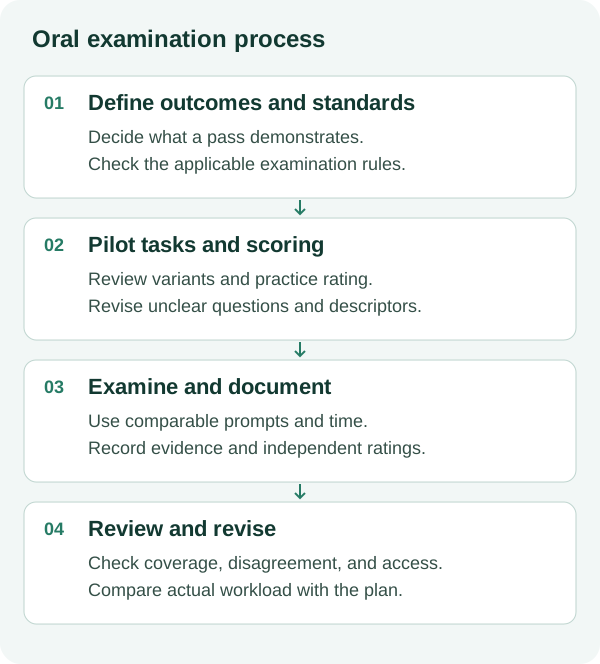
Work through the assessment in this order.
- Define the decision. Identify the learning outcomes, the oral component’s role in the course grade, and the evidence needed for a pass. Check the applicable regulations and accommodations.
- Write the assessment. Prepare the blueprint, task variants, planned follow-ups, rubric, and rules for combining scores. Pilot the questions and calibrate the examiners.
- Prepare the people and logistics. Give students instructions, examples, practice, and an accommodation route. Book examination, scoring, break, and contingency time.
- Examine and review. Record the evidence and independent ratings, resolve disagreements through the published procedure, return feedback, and review quality and workload.
Download the assessment blueprint, worked rubric, blank evidence and scoring sheet, and examiner script and readiness checklist. The CSV files are editable examples with synthetic content. Keep completed student records in approved institutional storage.
What the evidence supports
The strongest conclusion is conditional. A review of 17 undergraduate studies across several disciplines found that the value of oral assessment depends on its design, student preparation, and implementation. The review also reports anxiety, language concerns, and inconsistent marking. Several studies discuss reliability without measuring it adequately, so positive perceptions should be interpreted cautiously (Nallaya, Gentili, Weeks, & Baldock, 2024, pp. 635–641).
Health-professions research favors structured over traditional unstructured vivas. A review of 24 studies reports encouraging results, but the reported reliability coefficients come from individual settings. Its pooled estimate concerns student acceptability and has substantial heterogeneity. It does not establish a universal reliability coefficient for oral exams (Abuzied & Nabag, 2023, pp. 4–7). A 2026 review of 102 studies gives further support to structured formats and examiner preparation, while reporting substantial limitations in generalizability (Torab-Miandoab, Ghafourifard, Habibi-Chenaran, & Ghaffarifar, 2026, Abstract and Discussion).
Evidence outside medicine matters. In a biology study with cohorts of 99 and 29 students, oral assessment produced higher mean scores and greater nervousness than written assessment. The study found no evidence that particular groups were disadvantaged. Those findings cannot establish fairness for every population or show that higher oral marks necessarily indicate better learning (Huxham, Campbell, & Westwood, 2012, Abstract).
Large classes are feasible, with substantial staffing work. A 2026 study in introductory programming courses describes oral exams for more than 600 students. Its main evidence concerns graduate instructors’ experiences, including scheduling, training, fatigue, and workload. It does not establish that a five-minute exam provides sufficient evidence for a broad course-level decision (Ferrell & Post, 2026, secs. 3, 5–6).
Treat the procedures below as evidence-informed design recommendations. Validate the interpretation and use of scores in your own course, especially when moving between disciplines, degree levels, or examination purposes.
Define what students must demonstrate
Write the intended claim about the student in observable terms. For example, “The student can justify the choice of a regression model using its assumptions and the purpose of the analysis.” Then identify a response that would support that claim and a response that would contradict it.
An oral defense, an oral presentation, and an authorship check have different purposes. State which purpose contributes to the grade. A short authorship conversation offers limited evidence of the full range of course outcomes.
Separate subject understanding from oral communication. If the outcome concerns analysis, assess the quality of the analysis. If professional communication is itself an outcome, define and score it explicitly. Accent, eye contact, confidence, speed, and social ease are poor substitutes for disciplinary evidence. Queen’s University makes the same distinction in its oral-assessment design guidance (Queen’s University, Centre for Teaching and Learning, n.d., “Rubrics”).
For project work, examine each student’s reasoning about consequential choices and their ability to apply the learning. A student who can describe a completed report may still need to demonstrate why a method fits the problem. An individual theory test only supports the project’s outcomes when its tasks actually require those outcomes. Check that every assessment component supports the outcomes attributed to it. A defensible course grade depends on that correspondence.
Build a blueprint and question bank
A blueprint states what content and thinking the exam samples. Decide the required coverage for every student before selecting questions. Random selection within a topic does not establish that variants have comparable difficulty.
The following is an original example for a course assessing analytical reasoning. Each student receives all four task families. A 16-minute response period is a pilot starting point, not a validated minimum duration.
| Task family | Evidence sought | Example question | Pilot response time |
|---|---|---|---|
| Explain | Accurate interpretation | What does this coefficient mean in this case? | 4 min |
| Justify | A reasoned method choice | Why does this method fit the question and data? | 4 min |
| Critique | Recognition of limitations | Which assumption is least credible, and what follows? | 4 min |
| Transfer | Application to changed conditions | How would your conclusion change under this new condition? | 4 min |
Prepare a task card for every question. Include the outcome, initial prompt, required evidence, acceptable alternative answers, common misconceptions, planned probes, permitted assistance, timing, and relevant rubric criteria. Ask a colleague to answer and critique each card. Pilot the complete sequence with someone who did not write it.
Compare variants on the knowledge required, reasoning steps, reading load, unfamiliar context, and likely completion time. A change of names or numbers can change difficulty. Record each student’s variant so differences can be investigated later.
Plan follow-up questions
A planned follow-up can clarify an ambiguous answer or test a limitation. Joughin recommends planning the interaction and warns that excessive restriction can remove the opportunity to probe understanding (Joughin, 2010, pp. 10–14).
Use a written distinction between clarification, extension, and assistance. The following categories are proposed conventions for the worked example.
| Type | Example | How to document it |
|---|---|---|
| Clarification | “What do you mean by ‘significant’ here?” | Record the clarified explanation. |
| Extension | “Would that conclusion hold if observations were dependent?” | Use the planned extension and its relevant criterion. |
| Assistance | “You need to consider dependence between observations.” | Record the information supplied and apply the predeclared assistance rule. |
Give comparable opportunities to recover from an unclear opening answer. Avoid supplying one student with the missing reasoning while expecting another to produce it independently. Do not invent a numerical penalty for hints during the exam.
Create the rubric
An analytic rubric describes separate criteria and their performance levels. A review of 75 studies finds that rubrics can improve scoring consistency, particularly when they are analytic, specific to the task, and supported by exemplars or rater training. A rubric alone does not establish validity (Jonsson & Svingby, 2007, Abstract and Conclusions).
Choose the design explicitly. State who uses the rubric, what criteria and levels mean, how scores are combined, which examples explain the standard, and when students receive it. Dawson identifies 14 design decisions that distinguish rubrics (Dawson, 2017, Abstract).
Draft the sufficient-performance description first. Then describe weaker and stronger responses using observable differences. Replace labels such as “excellent understanding” with the actual reasoning an examiner should hear. Keep adjacent levels distinguishable. Avoid counting the same reasoning under several criteria unless the weighting deliberately reflects that choice.
Worked rubric
The rubric below is an original example for the blueprint in Table 1. It assesses subject reasoning. It has four equally weighted criteria and four performance levels. The labels and weights require piloting; this rubric has not been validated.
| Criterion | 0: insufficient evidence | 1: developing | 2: sufficient | 3: strong |
|---|---|---|---|---|
| Conceptual accuracy | Gives an explanation incompatible with the central concept, or provides no assessable explanation. | States parts of the concept but leaves a material error unresolved. | Explains the central concept correctly and resolves minor imprecision through clarification. | Gives a precise explanation and distinguishes a plausible misconception or boundary case. |
| Justification | Provides no relevant reason for the proposed choice. | Names a relevant reason but cannot connect it to the case. | Connects the choice to the question, evidence, and necessary assumptions. | Compares a credible alternative and explains when it would change the choice. |
| Evaluation of evidence | Treats an unsupported conclusion as established. | Identifies a limitation but cannot explain its consequence. | Identifies a consequential limitation and explains how it restricts the conclusion. | Weighs competing explanations and specifies evidence that could distinguish them. |
| Transfer | Cannot apply the concept to the changed condition. | Recognizes a relevant change but gives an inconsistent consequence. | Revises the reasoning or conclusion correctly for the changed condition. | Explains the revision and identifies a further condition under which it would cease to hold. |
Use level 0 only when the student had the planned opportunity to respond. Record a missed opportunity or interrupted session separately.
Use task-specific answer notes alongside the rubric. For a regression question, specify which assumptions matter, what interpretations are acceptable, and which errors change the conclusion. The general rubric cannot supply that disciplinary detail.
An original scoring illustration is a response rated 2, 2, 1, and 2. The mean is 1.75 out of 3. That arithmetic is not a pass decision. A course could require a minimum on every essential outcome or allow specified compensation. Choose the approved rule before the exam, explain it to students, and apply it consistently. Do not convert these levels mechanically to a 1-to-10 grade without a justified local conversion.
Set the pass standard
Specify what a minimally sufficient student must demonstrate and how that standard relates to course regulations. Ask knowledgeable colleagues to judge examples near the boundary, document their reasons, and resolve uncertainty before use. Norcini describes standard setting as a judgment process that should fit the assessment purpose and draw on expertise, evidence, and a documented procedure (John J. Norcini, 2003, Abstract).
For a consequential examination, obtain assessment expertise to choose and run an established standard-setting method. Angoff-type judgments and borderline-performance methods require different evidence and assumptions. Small classroom samples may provide too little information for stable empirical borderline estimates. A desired pass rate is not sufficient justification for moving a threshold after seeing the cohort’s results.
Prepare examiners and students
Calibrate the examiners
Have examiners independently score the same practice responses before discussing them. Include a clearly insufficient response, a response near the pass boundary, and a strong response. Compare criterion ratings and the evidence used, revise ambiguous descriptors, then independently score new examples. Flinders University recommends moderation and discussion with markers and students before assessment begins (Flinders University, n.d., “Caveats”).
Keep the original ratings. Agreement reached after discussion cannot measure initial agreement. Decide in advance how a disputed grade is reviewed, who adjudicates, and what evidence they receive. When two examiners attend, let each record a rating before seeing the other’s score.
Use a short recalibration exercise between examination blocks if fatigue or changes in interpretation appear. Record which rubric version applies to each session. A defect discovered during an exam series requires a documented response that considers all affected students.
Prepare the students
Provide the purpose, outcomes, format, timing, rubric, permitted materials and tools, recording arrangements, feedback procedure, and review route. Demonstrate a sample exchange and let students practice with feedback. Explain how pauses, clarification requests, and corrections are handled.
Theobold’s statistics-course example uses advance question banks and a rubric, supported by earlier opportunities to explain ideas. Its ten-minute, two-question format is a documented implementation choice (Theobold, 2021, sec. 3). Rubrics can also support learning, but evidence of improved performance does not establish reduced anxiety or greater scoring agreement (Panadero, Jonsson, Pinedo, & Fernández-Castilla, 2023, Abstract).
Arrange accommodations through the established institutional route before scheduling. Consider processing time, hearing or speech access, assistive technology, language demands, and the suitability of the setting. Preserve the intended outcome while removing barriers unrelated to it. Give examiners the necessary practical arrangements while limiting access to personal information.
Administer the exam consistently
Use the same opening procedure and timing conventions. Confirm identity through the institution’s approved process, explain the sequence, and verify any recording. Present one prompt at a time. Allow the planned thinking time and make a written prompt available where appropriate.
The following opening is an original script for the worked example.
You will answer four questions about interpretation, method choice, evidence, and application. You may pause to think, ask me to repeat a question, or correct an answer. I may ask a follow-up to clarify your reasoning. I will make notes against the published criteria. We will explain your result through the course’s published feedback procedure.
Add the approved recording notice and accommodation instructions. Avoid an assurance that every form of help leaves scoring unchanged.
During the exam, write brief factual notes against the criterion and question. “Named independence only after the examiner supplied it” is more useful than “seemed weak.” Record material assistance, interruptions, and unfinished tasks. Move on according to the planned time rule so one difficult answer does not remove every later opportunity.
For group project defenses, allocate questions and response time to each student. Require an individual answer before inviting group discussion. Keep individual evidence and grades distinguishable from the quality of the shared product.
Complete the score sheet immediately after the response period. Preserve independent ratings, document moderation, and provide criterion-based reasons for the final grade. Give the student a specific improvement action, such as explaining how an assumption affects a conclusion.
Online examinations and incidents
Test the platform, waiting room, sound, shared material, and recording location. Publish the permitted-tool policy and the procedure for connection failure, late arrival, illness, and rescheduling. Keep a reserve appointment period. A technical failure should be recorded separately from evidence of academic performance.
For a disrupted session, record when it stopped, what was completed, and what material was exposed. Follow the approved restart or resit procedure using an appropriate equivalent task. Avoid improvising a different pass standard for the affected student.
An oral exam can make individual reasoning more observable, but a hesitant response cannot establish unauthorized AI use. Distinguish assessment of achievement from an investigation of suspected misconduct. Follow the applicable reporting and hearing procedure. The BMS Rules and Regulations describe an additional oral inspection under specified conditions and place misconduct decisions with the examination board (University of Twente, BMS Examination Boards, 2026, sec. 7.1.1).
Check reliability and fairness
Reliability concerns the consistency of the decision under relevant changes in questions, examiners, and occasions. Two examiners can agree about a student’s answer to a narrow question while a different question would produce a different result. A certification study illustrates this problem: acceptable inter-rater agreement coexisted with low generalizability across sessions (Turnbull, Danoff, & Norman, 1996, Abstract).
Start with records you can inspect. Retain question variants, coverage, independent criterion ratings, final decisions, assistance, timing, and incidents. Review a planned spread of responses across performance levels and examiners, including pass-boundary cases. Keep absences, incomplete sessions, and technical failures visible in the denominator. Do not code missing opportunities as demonstrated incompetence.
Report exact criterion agreement, pass/fail disagreement, and the reasons for differences. For numerical ratings, an appropriate intraclass correlation coefficient can help. Specify whether it measures absolute agreement or consistency, single or averaged ratings, and the rater model; report uncertainty (Koo & Li, 2016). An examiner who consistently awards higher scores can correlate strongly with a colleague while disagreeing about grades.
For a high-stakes assessment, use a design that can estimate variation across students, tasks, and raters, with specialist help where needed. Generalizability analysis is useful only when the sampling design supports its intended interpretation. A single local agreement statistic cannot establish consistency across a whole domain.
Choose quality criteria according to the decision’s consequences. Norcini cautions against applying a reliability threshold such as .80 as a universal rule; measurement error and consistency of pass/fail decisions may be more informative (J. J. Norcini, 1999, Abstract). Review fairness through question access, accommodation delivery, assistance, examiner patterns, and student feedback. A difference between groups warrants investigation; a small sample or a nonsignificant difference cannot establish absence of bias.
Budget the full workload
Count staff hours as well as elapsed examination time. Parallel panels shorten the timetable while retaining the staff time each panel consumes. Include question development, calibration, scheduling, accommodations, scoring, moderation, feedback, and administration.
An original planning calculation is:
\[ H_{\text{staff}}=H_{\text{design}}+H_{\text{training}}+H_{\text{administration}}+ \frac{N\{r(t_{\text{response}}+t_{\text{scoring}}+t_{\text{buffer}})+t_{\text{feedback}}\}}{60}. \]
Here, \(N\) is the number of students, \(r\) is the number of examiners simultaneously assigned to each appointment, and the \(t\) values are minutes per student. Fixed terms are total staff hours. Add separate moderation and resit work when they are not already included. The calculation assumes the same examiners remain assigned during scoring and buffer time.
For 120 students, a 16-minute response, 4 minutes for scoring, and a 2-minute buffer require 44 appointment hours for one examiner. Two examiners require 88 staff hours. Two parallel pairs can complete the appointments in about 22 hours of timetable time, before shared breaks and contingencies. Two minutes of separate feedback per student add 4 staff hours. These are illustrative inputs, not observed course costs.
Record actual times during the pilot and revise the budget. Ferrell and Post report workload and fatigue concerns despite brief appointments. Their experience supports protected breaks, reserve slots, instructor preparation, and feedback from the examining team (Ferrell & Post, 2026, secs. 5–6).
Efficiency choices include reducing repeated presentations, reusing reviewed task cards, and entering evidence directly in the scoring form. A shorter oral may be appropriate when it assesses a narrowly defined outcome alongside other evidence. Broad claims about course mastery need enough sampling to support them.
Resolve the main trade-offs
| Choice | Benefit | Cost or risk | Recommended use |
|---|---|---|---|
| Common prompts and planned probes | Comparable opportunities with room to clarify reasoning. | Requires a reviewed bank and rules for assistance. | Default starting design for course exams. |
| Highly scripted questioning | Easier delivery and coverage checks. | Can miss an unexpected but valid explanation. | Use when tasks are narrow; permit documented clarification. |
| Open discussion | Can reveal complex reasoning in depth. | Coverage, difficulty, and help may vary. | Use with experienced examiners and a defined evidence plan. |
| Two live examiners | Independent judgments and contemporaneous review. | More staff hours; shared discussion can conceal disagreement. | Use where required or justified by stakes; rate independently. |
| One examiner plus recording | Lower live staffing demand and a reviewable record. | Later review costs time; recording does not improve initial scoring by itself. | Use only within approved rules, with a planned moderation process. |
| Advance question bank | Predictable preparation and opportunities to rehearse reasoning. | Rehearsed answers may conceal limited transfer. | Publish scope and examples; test justified application or changed conditions. |
| More topics or stations | Broader sampling of achievement. | Less depth per topic or more time overall. | Match breadth to the claim; pilot the complete examination. |
| Group defense | Efficient discussion of a shared product. | Dominant speakers can obscure individual achievement. | Require identifiable individual answers and sufficient time per person. |
The evidence does not establish a universally best duration, number of raters, or rubric size. Preserve the aspects of dialogue that elicit the intended reasoning while controlling differences that would make grades depend on the appointment or examiner (Joughin, 2010, pp. 10–16).
University of Twente BMS requirements
This section concerns BMS and was checked on October 28, 2026. Teachers elsewhere should replace it with their own current rules. The EER, programme-specific provisions, approved assessment plan, and examination-board rules govern local decisions.
The 2026/2027 BMS Bachelor EER says oral assessment is generally not public, with specified exceptions and a procedure for third-party attendance. Article 3.3.9 sets the oral-result deadline at one working day, or one working day after the end of a multi-day series. Article 3.10 establishes discussion and inspection rights. Use the current applicable regulation when a general teaching webpage differs (University of Twente, Faculty BMS, 2026a, arts. 3.3.9, 3.7 and 3.10).
The public BMS storage protocol, version May 28, 2026, is a guiding framework from which no legal rights may be derived. It describes recording or the presence of a second assessor, with advance notice through Canvas. Every exam has an assessment form containing criteria, reasons, and grade, made available to students. Recordings support assessment and appeals, use restricted P-drive storage, and are deleted no later than two months after grade publication unless a procedure remains ongoing. Assessment forms follow the two-year archiving procedure. Coordinate storage and destruction with the programme secretariat (University of Twente, Faculty BMS, 2026b, secs. 1–6).
The protocol is guidance within the applicable examination regulations. A recording does not replace the assessment form. Confirm the arrangements with the programme before the exam, including responsibility for deletion and an appeal hold. Keep student records and recordings out of public article folders.
The examination packet
Before the first graded session, assemble a reviewed packet containing the outcomes and decision rules, blueprint and task cards, rubric and scored exemplars, and examiner instructions. Add the student information, accommodation arrangements, schedule, incident procedure, and storage responsibilities.
After each session, retain the completed evidence sheet and ratings through the approved institutional route. After the series, review disagreements, coverage, incidents, fairness concerns, student experience, and actual staff hours. Record the changes required for the next version. A course team can then explain both how it reached a student’s grade and what evidence supports continued use of the exam.
Evidence and scope
This manual is a targeted narrative synthesis, not a systematic review. It combines accessible research and primary university guidance checked on October 28, 2026. Full texts and relevant sections were inspected where accessible; bibliographic metadata was checked against publishers and Crossref. Some older research is available here only through its abstract or an existing review and supports correspondingly limited claims.
The worked blueprint, rubric, scripts, and workload example are original illustrations. They are not validated instruments or University of Twente policy. Medical certification findings need particular caution when applied to undergraduate course exams. Current reviews also discuss AI-assisted assessment; their discussion does not establish that automated oral grading is sufficiently valid or fair for a consequential local decision.