Warehouse design challenges
Almost all quality improvement comes via simplification of design, manufacturing… layout, processes, and procedures. Tom Peters
🧠 Learning objectives
- Recognize the complexity of warehouse design decisions.
- Identify key warehouse design activities.
Warehouse design challenges
- Design decisions are tightly coupled:
- Decisions cannot be analyzed or determined in isolation from the others.
- Addressing one decision requires a research infrastructure integrating all the other decisions.
- Commonly, available models are not unified or interoperable.
- Evaluating the impact of changing a design decision requires estimating changes in warehouse operation (e.g., via simulation or queueing theory).
Block layout (macro) vs. detailed layout (micro)
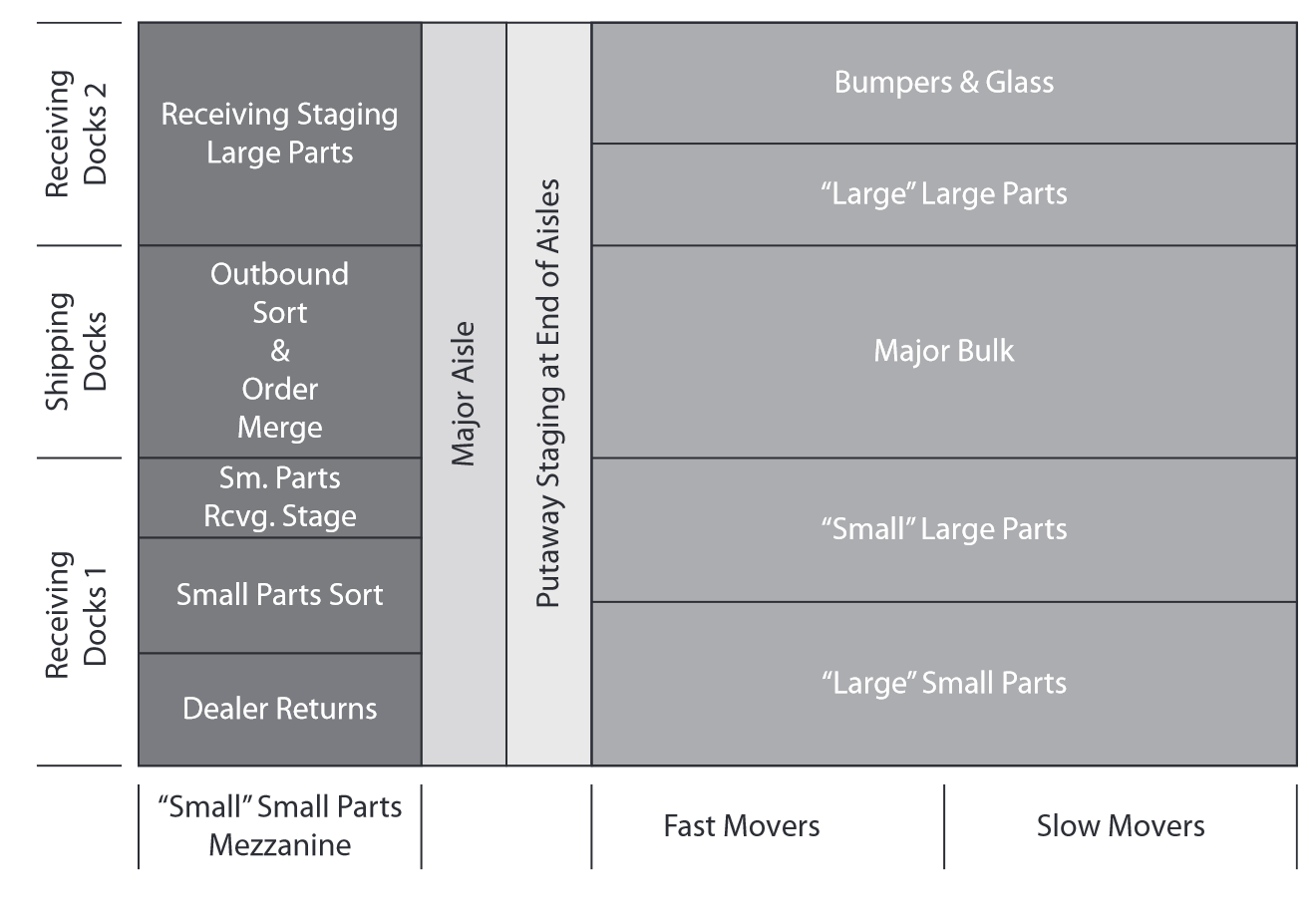
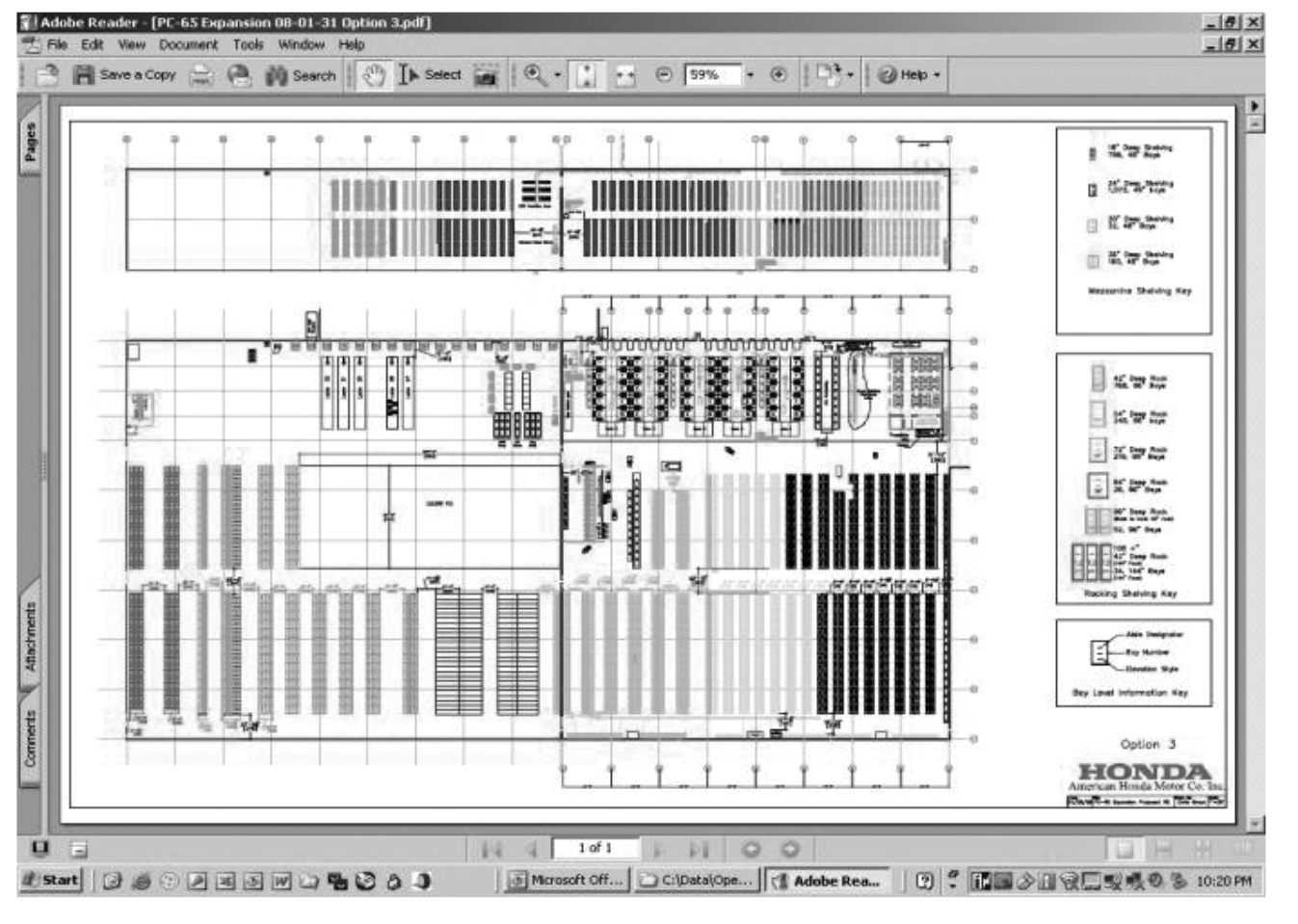
Design and Layout
Main activities:
- Overall structure
- Sizing and dimensioning
- Department layout
- Equipment selection
- Operation strategy (storage & order-picking)
Overall structure (conceptual design)
Determines the functional departments, for example:
- how many storage departments,
- employing what technologies, and
- how orders will be assembled.
Goal: Meet storage and throughput requirements and to minimize costs.
Example 1 (Considering only storage and throughput)
Build a warehouse to store 10,000 pallets and ship 1,000 pallets per day.
Overall structure: service and product requirements
Example 2 (Considering service level)
Build a warehouse to store 10,000 pallets and ship 1,000 pallets per day, with 95% of orders shipped within 2 hours of receipt.
Example 3 (Considering product characteristics)
Build a warehouse to store 10,000 pallets of Cocoa and ship 1,000 pallets per day, with 95% of orders shipped within 2 hours of receipt.
Sizing and dimensioning
Warehouse sizing and dimensioning have important implications on:
- construction costs
- inventory holding and replenishment, and
- material handling.
Most research focuses on single-department warehouses, treating sizing and dimensioning separately.
Sizing
Determines the storage capacity of a warehouse. Scenarios:
- Inventory levels are determined externally (e.g., public warehouse)
- Stochastic demand for storage space has to be satisfied.
- Warehouse can directly control the inventory policy (e.g., independent wholesale distributor)
- Inventory policy and inventory costs should be considered in solving the sizing problem (e.g., reorder point and order quantity).
Common assumptions:
- Additional space can be leased.
- Costs: facility construction, inventory holding, replenishment, storage demand not satisfied (e.g., lost sales).
Capacity requirements should consider seasonality, storage policy, and order characteristics.
Dimensioning
- Translates capacity into floor space in order to assess construction and operating costs.
- Example (block stacking):
- 1 pallet = \(1.2 \text{ m} \times 1.0 \text{ m}\)
- 10,000 pallets = 12,000 m² + aisles + staging
- If stack height = 3, then 4,000 m² + aisles + staging
Assumptions:
- Single storage department
- Multiple storage departments (e.g., forward-reserve configuration)
A key issue with all research on the dimensioning problem is that it requires performance models of material handling; these models are often independent of the size or layout of the warehouse. Gu et al. (2010)
(Storage) Department layout
Storage department layout problems:
Pallet block-stacking pattern
- storage lane depth
- stack height
- pallet placement angle with regards to the aisle
- storage clearance between pallets
- Number of lanes for each depth
Storage department layout
- door location
- aisle orientation
- number, length, and width of aisles
AS/RS configuration
- dimension of storage racks
- Number of cranes
KPIs affected by layout problems:
- construction and maintenance cost;
- material handling cost;
- storage capacity (e.g., the ability to accommodate incoming shipments);
- space utilization; and
- equipment utilization.
Equipment selection
Addresses two strategic decisions:
- Level of automation (commonly determined by designers and managers based on experience)
- Storage and material handling systems
For example, what is best considering operational, floor space, and equipment costs:
- Block stacking, single-/double-deep pallet rack, deep lane storage, or unit load AS/RS?
- Shelving systems, modular drawers, gravity flow racks, carousel systems, or mini-load storage/retrieval systems?
Fundamental issues:
- How to identify the equipment alternatives that are reasonable for a given storage/retrieval requirement?
- How to select among the reasonable alternatives?
Operation strategy
Once selected, operation strategies have important effects on the overall system and are not likely to be changed frequently.
Two major operation strategies are discussed:
- Storage strategy (e.g., randomized, dedicated)
- Order picking strategy (e.g., zone picking)
Storage strategy
May have significant impact on capacity or travel time. Basic strategies include:
- Random storage
- Dedicated storage
- Class-based storage
- Duration-of-Stay (DOS) based storage.
Order-picking strategy
Order-picking organization and planning must answer the following questions:
- Part-to-picker or picker-to-part?
- Wave-picking? How many waves of what duration?
- Will the warehouse be divided into zones? If so, will zones be picked sequentially or concurrently?
- Single or batch order picking? If batched, sorting while picking or after picking?
Depending on the operating principles selected, the order picking methods will be:
- Single order picking
- Batching with sort-while-pick
- Batching with sort-after-pick
- Sequential zoning with single order picking
- Sequential zoning with batching
- Concurrent zoning without batching
- Concurrent zoning with batching
Order-picking: Common research pitfalls
For each order picking policy:
- The simplest rules regarding batching, routing, and wave duration are used.
- Performance measures are mainly related to order picking efficiencies and service quality; additional costs caused by downstream sorting with batch, zone, and wave picking are not considered.
- Policy comparison considers only order structures, while other important factors such as storage assignment and detailed implementation are assumed to be fixed.
References
Frazelle, Edward. 2016. World-Class Warehousing and Material Handling. Second Edition. McGraw-Hill Education.
Gu, Jinxiang, Marc Goetschalckx, and Leon F. McGinnis. 2010. “Research on Warehouse Design and Performance Evaluation: A Comprehensive Review.” European Journal of Operational Research 203 (3): 539–49. https://doi.org/10.1016/j.ejor.2009.07.031.
Warehousing - M-IEM - Breno A. Beirigo