Storage Location Assignment Problem
A place for everything, and everything in its place Benjamin Franklin
Learning Goals
- Define SLAP and explain dominant cost drivers in picking.
- Distinguish storage policies, ranking rules, and routing impacts.
- Understand DSLAP, including re-warehousing versus healing and how to evaluate net gain.
What is SLAP?
- The Storage Location Assignment Problem (SLAP) assigns stock-keeping units (SKUs) to physical locations in a warehouse.
- The goal is to determine an optimal assignment that minimizes an operational criterion, typically expected picker travel or order cycle time.
- Synonyms include storage assignment, product allocation, slotting, and storage location problem (Medrano-Zarazúa et al. 2024; Reyes et al. 2019).
Why SLAP Matters
- Picking is a large share of warehouse labor.
- Travel time often dominates pick time in picker-to-parts systems.
- Proximity to I/O and golden-zone placement (i.e., waist-to-shoulder height) reduces reach and travel (Petersen et al. 2005).
- Assigning most picked items to the most convenient locations reduces overall travel.
SLAP Baseline Formulation
Let \(I\) be items and \(L\) locations. Decision \(x_{i\ell}\in\{0,1\}\) equals 1 if item \(i\) is at location \(\ell\) with cost \(c_{i\ell}\).
Objective:
\[\min \sum_{i\in I}\sum_{\ell\in L} c_{i\ell}\,x_{i\ell}\]
Constraints:
- \(\sum_{\ell\in L} x_{i\ell}=1\ \forall i\) (assign each item)
- \(\sum_{i\in I} x_{i\ell}\le 1\ \forall \ell\) (assign at most one item per location)
- \(x_{i\ell}\in\{0,1\}\)
Where:
- \(c_{i\ell}\) is a travel or time proxy derived from a routing policy.
Travel-time Models and Cost Construction
- The choice of \(c_{i\ell}\) is critical: how should we estimate the cost of placing item \(i\) at location \(\ell\)?
- Closed-form expressions for route length under standard routing policies (e.g., Return, S-shape, Largest-gap) can inform \(c_{i\ell}\) (see, e.g., Dijkstra and Roodbergen 2017).
Storage Policies, Ranking Rules, and KPIs
- Policies. Dedicated, Random/Open-location, Class-based, Golden-zone, Similarity or family grouping, Forward–reserve two-tier, and shared storage with duration-of-stay (see, e.g., Petersen et al. 2005; Manzini et al. 2015; Walter et al. 2013).
- Ranking rules. Popularity or frequency, Turnover, Volume, Pick-density, COI, Velocity-based, Recency-based (see, e.g., Heskett 1963; Chou et al. 2012; Reyes et al. 2019).
- KPIs. Distance and time, aisle changes, relocations per day, labor-hours, energy and ergonomics when relevant.
Variants and Modeling Extensions
SLAP variants reflect constraints and objectives found in practice, such as:
- Class-based. Decide class boundaries and map classes to areas (Manzini et al. 2015; Muppani and Adil 2008).
- Shared storage with duration-of-stay. Minimize peak load and balance space when items share locations over time (Chen et al. 2010).
- Forward–reserve sizing and allocation. Jointly size forward and reserve areas and assign SKUs (Walter et al. 2013; Heragu et al. 2005).
- Correlated demand and affinity. Co-locate items that are often co-picked or linked in BOMs (Bill of Materials) (Mantel et al. 2007; Zhang et al. 2019; Xiao and Zheng 2010).
- Ergonomics and human factors. Integrate golden-zone reach and energy expenditure (Petersen et al. 2005; Battini et al. 2016).
- Automation contexts. AS/RS, shuttles, robotic systems, and RFID-enabled storage decisions (Chen et al. 2010; Ramtin and Pazour 2015; Yang et al. 2015; Choy et al. 2017).
- Multi-criteria decision making. ELECTRE TRI, TOPSIS, efficient frontiers, and hybrid MCDM–optimization (Micale et al. 2019; Fontana and Cavalcante 2014; Fontana and Nepomuceno 2017).
Reassignment Upon Demand Changes
- Static SLAP assumes constant demand and a one-time assignment.
- Dynamic/multi-period SLAP reassigns SKUs over time as demand changes (see, e.g., Kofler et al. 2012).
- Goal: Balance reassignment costs with operational savings in picking efficiency.
- Strategies:
- Re-warehousing performs large periodic redesigns (many moves, high disruption).
- Healing performs frequent small swaps (fewer moves, low disruption) (see, e.g., Kofler et al. 2011, 2012).
Overview of Approaches for Product Reassignment
| Strategy name | Full rearrangement | Healing | Healing |
|---|---|---|---|
| Impact on daily operation | High | Medium | Low |
| Problem name | Storage location assignment problem | Rearrange-while-working problem | Warehouse reassignment problem |
| Customer demand | Static | Dynamic | Dynamic |
| Typical objective | Minimize average order-picking time | Minimize total time of picking + relocations | Minimize time to perform relocations |
| Typical constraints | None | Picking jobs + desired final storage location assignment | Desired final storage location assignment |
How to Transition from One Setup to Another
- Transitioning from one assignment to another incurs material handling costs.
- How can several product switches achieve an optimal transition?
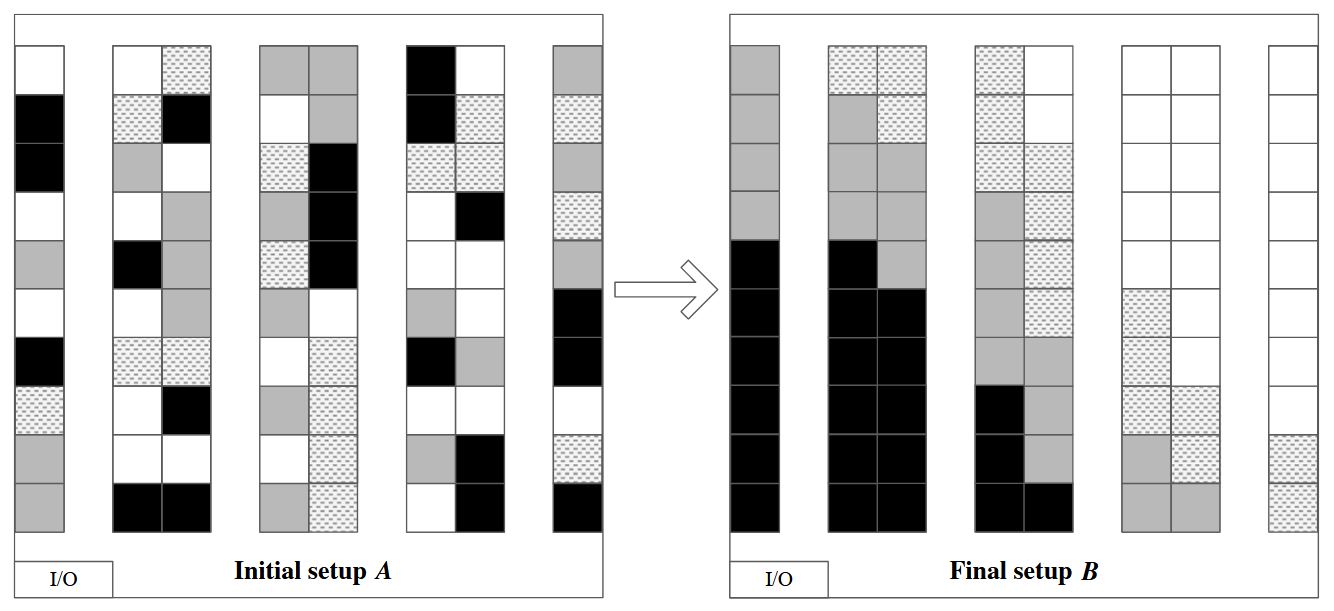
Example of warehouse reassignment problem. Locations are colored by picking frequency: black = most frequent, white = least frequent. Left: Initial assignment. Right: New best assignment based on demand fluctuations (Chabot et al. 2024).
Evaluation by Discrete-Event Simulation
- Frequently, closed-form cost proxies \(c_{i\ell}\) omit key operational factors.
- Discrete-event simulation (DES) can capture batching, routing, congestion, calendars, and stochasticity (see, e.g., León et al. 2023).
References
Battini, Daria, Alessandro Persona, Fabio Sgarbossa, and Tiziano Tessaro. 2016. “Human Energy Expenditure in Order Picking Storage Assignment: A Bi-Objective Method.” Computers & Industrial Engineering 94: 147–57. https://doi.org/10.1016/j.cie.2016.01.020.
Chabot, Thomas, Leandro C. Coelho, Jacques Renaud, and Kees Jan Roodbergen. 2024. “Mathematical Models for the Warehouse Reassignment Problem.” In Warehousing and Material Handling Systems for the Digital Industry: The New Challenges for the Digital Circular Economy, edited by Riccardo Manzini and Riccardo Accorsi. Springer International Publishing. https://doi.org/10.1007/978-3-031-50273-6_6.
Chen, Lu, André Langevin, and Diane Riopel. 2010. “The Storage Location Assignment and Interleaving Problem in an Automated Storage/Retrieval System with Shared Storage.” International Journal of Production Research 48 (4): 991–1011. https://doi.org/10.1080/00207540802506218.
Chou, Yon-Chun, Yao-Hung Chen, and Hui-Min Chen. 2012. “Recency-Based Storage Assignment and Warehouse Configuration for Recurrent Demands.” Computers & Industrial Engineering 62 (4): 880–89. https://doi.org/10.1016/j.cie.2011.12.009.
Choy, K. L., G. T. S. Ho, and C. K. H. Lee. 2017. “A RFID-based Storage Assignment System for Enhancing the Efficiency of Order Picking.” Journal of Intelligent Manufacturing 28 (1): 111–29. https://doi.org/10.1007/s10845-014-0965-9.
Dijkstra, Arjan S., and Kees Jan Roodbergen. 2017. “Exact Route-Length Formulas and a Storage Location Assignment Heuristic for Picker-to-Parts Warehouses.” Transportation Research Part E: Logistics and Transportation Review 102: 38–59. https://doi.org/10.1016/j.tre.2017.04.003.
Fontana, Marcele Elisa, and Carlos A. V. Cavalcante. 2014. “Using the Efficient Frontier to Obtain the Best Solution for the Storage Location Assignment Problem.” Mathematical Problems in Engineering 2014. https://doi.org/10.1155/2014/745196.
Fontana, Marcele Elisa, and Vilmar Santos Nepomuceno. 2017. “Multi-Criteria Approach for Products Classification and Their Storage Location Assignment.” The International Journal of Advanced Manufacturing Technology 88 (9–12): 3205–16. https://doi.org/10.1007/s00170-016-9040-3.
Heragu, S. S., L. Du, R. J. Mantel, and P. C. Schuur. 2005. “Mathematical Model for Warehouse Design and Product Allocation.” International Journal of Production Research 43 (2): 327–38. https://doi.org/10.1080/00207540412331285841.
Heragu, Sunderesh S. 2022. Facilities Design. Fifth edition. CRC Press.
Heskett, John L. 1963. “Cube-Per-Order Index: A Key to Warehouse Stock Location.” Transportation and Distribution Management 3 (1): 27–31.
Kofler, Monika, Andreas Beham, Stefan Wagner, Michael Affenzeller, and Werner Achleitner. 2011. “Re-Warehousing Vs. Healing: Strategies for Warehouse Storage Location Assignment.” Proceedings of the 3rd IEEE International Symposium on Logistics and Industrial Informatics (LINDI), 77–82. https://doi.org/10.1109/LINDI.2011.6031124.
Kofler, Monika, Andreas Beham, Stefan Wagner, Michael Affenzeller, and Werner Achleitner. 2012. “The Multi-Period Storage Location Assignment Problem.” Proceedings of IEEE APCAST’12, 38–41.
León, José F., Yan Li, Mohammad Peyman, Laura Calvet, and Angel A. Juan. 2023. “A Discrete-Event Simheuristic for Solving a Realistic Storage Location Assignment Problem.” Mathematics 11 (7): 1577. https://doi.org/10.3390/math11071577.
Mantel, Ronald J., Peter C. Schuur, and Sunderesh S. Heragu. 2007. “Order Oriented Slotting: A New Assignment Strategy for Warehouses.” European Journal of Industrial Engineering 1 (3): 301–16. https://doi.org/10.1504/EJIE.2007.014689.
Manzini, Riccardo, Riccardo Accorsi, Mauro Gamberi, and Stefano Penazzi. 2015. “Modeling Class-Based Storage Assignment over Life Cycle Picking Patterns.” International Journal of Production Economics 170 (December): 790–800. https://doi.org/10.1016/j.ijpe.2015.06.026.
Medrano-Zarazúa, Lucy, Jania Astrid Saucedo-Martínez, and Johanna Bolaños-Zuñiga. 2024. “Storage Location Assignment Problem in a Warehouse: A Literature Review.” In Computer Science and Engineering in Health Services, edited by José Antonio Marmolejo-Saucedo, Roman Rodríguez-Aguilar, Pandian Vasant, Igor Litvinchev, and Brenda M. Retana-Blanco. Springer International Publishing. https://doi.org/10.1007/978-3-031-34750-4_2.
Micale, Riccardo, Carmelo Maria La Fata, and Giuseppe La Scalia. 2019. “A Combined Interval-Valued ELECTRE TRI and TOPSIS Approach for Solving the Storage Location Assignment Problem.” Computers & Industrial Engineering 135: 199–210. https://doi.org/10.1016/j.cie.2019.06.011.
Muppani, Venkata Reddy, and Gajendra Kumar Adil. 2008. “A Branch and Bound Algorithm for Class Based Storage Location Assignment.” European Journal of Operational Research 189 (2): 492–507. https://doi.org/10.1016/j.ejor.2007.05.050.
Petersen, Charles G., Christina Siu, and Daniel Heiser. 2005. “Improving Order Picking Performance Utilizing Slotting and Golden Zone Storage.” International Journal of Operations & Production Management 25 (10): 997–1012. https://doi.org/10.1108/01443570510619491.
Ramtin, Faraz, and Jennifer A. Pazour. 2015. “Product Allocation Problem for an AS/RS with Multiple in-the-Aisle Pick Positions.” IISE Transactions 47 (12): 1379–96. https://doi.org/10.1080/0740817X.2015.1027458.
Reyes, Juan José Rojas, Elyn Lizeth Solano-Charris, and Jairo Rafael Montoya-Torres. 2019. “The Storage Location Assignment Problem: A Literature Review.” International Journal of Industrial Engineering Computations, 199–224. https://doi.org/10.5267/j.ijiec.2018.8.001.
Walter, Rico, Nils Boysen, and Armin Scholl. 2013. “The Discrete Forward–Reserve Problem – Allocating Space, Selecting Products, and Area Sizing in Forward Order Picking.” European Journal of Operational Research 229 (3): 585–94. https://doi.org/10.1016/j.ejor.2013.02.047.
Xiao, Jian, and Li Zheng. 2010. “A Correlated Storage Location Assignment Problem in a Single-Block-Multi-Aisles Warehouse Considering BOM Information.” International Journal of Production Research 48 (5–6): 1321–38. https://doi.org/10.1080/00207540802555736.
Yang, Peng, Lixin Miao, Zhaojie Xue, and Bin Ye. 2015. “Variable Neighbourhood Search Heuristic for Storage Location Assignment and Storage/Retrieval Scheduling Under Shared Storage in Multi-Shuttle Automated Storage/Retrieval Systems.” Transportation Research Part E: Logistics and Transportation Review 79: 164–77. https://doi.org/10.1016/j.tre.2015.04.009.
Zhang, Ren-Qian, Meng Wang, and Xing Pan. 2019. “New Model of the Storage Location Assignment Problem Considering Demand Correlation Pattern.” Computers & Industrial Engineering 129: 210–19. https://doi.org/10.1016/j.cie.2019.01.027.
Warehousing - M-IEM - Breno A. Beirigo