4 Warehouse systems
A warehousing system combines hardware with operating processes. Hardware includes racks, shelves, conveyors, automated guided vehicles, pick-by-voice devices, and mobile robots. Processes include sequential zone picking and batch picking.
Two warehouse-system archetypes differ in who travels the final picking distance: picker-to-parts (P2P) and parts-to-picker (PtP), also called goods-to-person (GTP). Each archetype requires different layout, equipment, and control decisions.
The framework from Boysen and de Koster (2025) organizes both archetypes into 3 technology generations.
Picker-to-parts (P2P)
People, often with carts or trucks and sometimes with light assistance, travel to storage to retrieve SKUs. Design and control focus on reducing travel and congestion through layout, slotting, batching, routing, and simple mechanization.

Generational view
- Generation 1: Basic manual travel. Paper lists, manual routing such as S-shape1 or largest-gap2, limited consolidation aids. Travel time of pickers dominates performance.
- Generation 2: Extended mechanization. Conveyors for pick-to-belt or pick-to-tote, pick-to-light or voice, structured zoning and waves, carton-flow forward areas that reduce walk distance.
- Generation 3: Robot-supported P2P. Mobile aids or autonomous mobile robots (AMRs) reduce walking while people still pick at the storage face. Release and batching policies respond to current congestion.
Examples
Figure Figure 4.2 shows a conventional parallel-aisle installation where picker travel dominates and slotting3 plus routing rules are central.

Figure Figure 4.3 illustrates carton-flow lanes used in pick-and-pass modules to shorten walking and stage orders across adjacent zones.
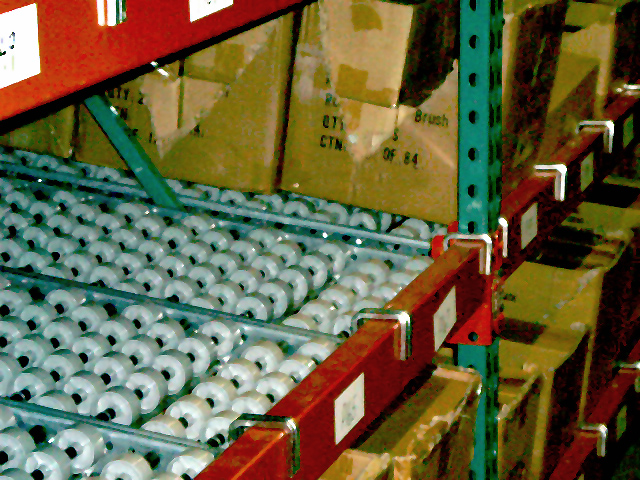
Figure Figure 4.4 shows a pick-to-belt line where items are deposited to a conveyor or tote stream for centralized accumulation and sortation.

Figure Figure 4.5 shows a horizontal carousel applied locally to shrink within-zone walking while pickers still relocate between nearby zones.

Parts-to-picker (PtP) and goods-to-person (GTP)
Automated equipment brings inventory to stationary pickers or robots at workstations. Performance then depends on the capacity and synchronization of storage and transport subsystems.
Generational view
- Generation 1. Classic GTP mechanisms. Unit-load or mini-load automated storage and retrieval systems (AS/RS) cranes and carousels feed manned stations, sequencing is limited, buffers are small, and station counts are low.
- Generation 2. Throughput-oriented extensions. Shuttle systems decouple horizontal and vertical moves, explicit sequencing buffers appear, station counts and sorter rates rise.
- Generation 3. Robotized GTP. Cube-storage robots and mobile-shelf systems deliver bins or pods, some stations feature robotic picking for suitable items, synchronization between buffers and stations becomes critical.
Examples
Figure Figure 4.6 shows how a mini-load AS/RS supplies goods-to-person stations in Generation 1.
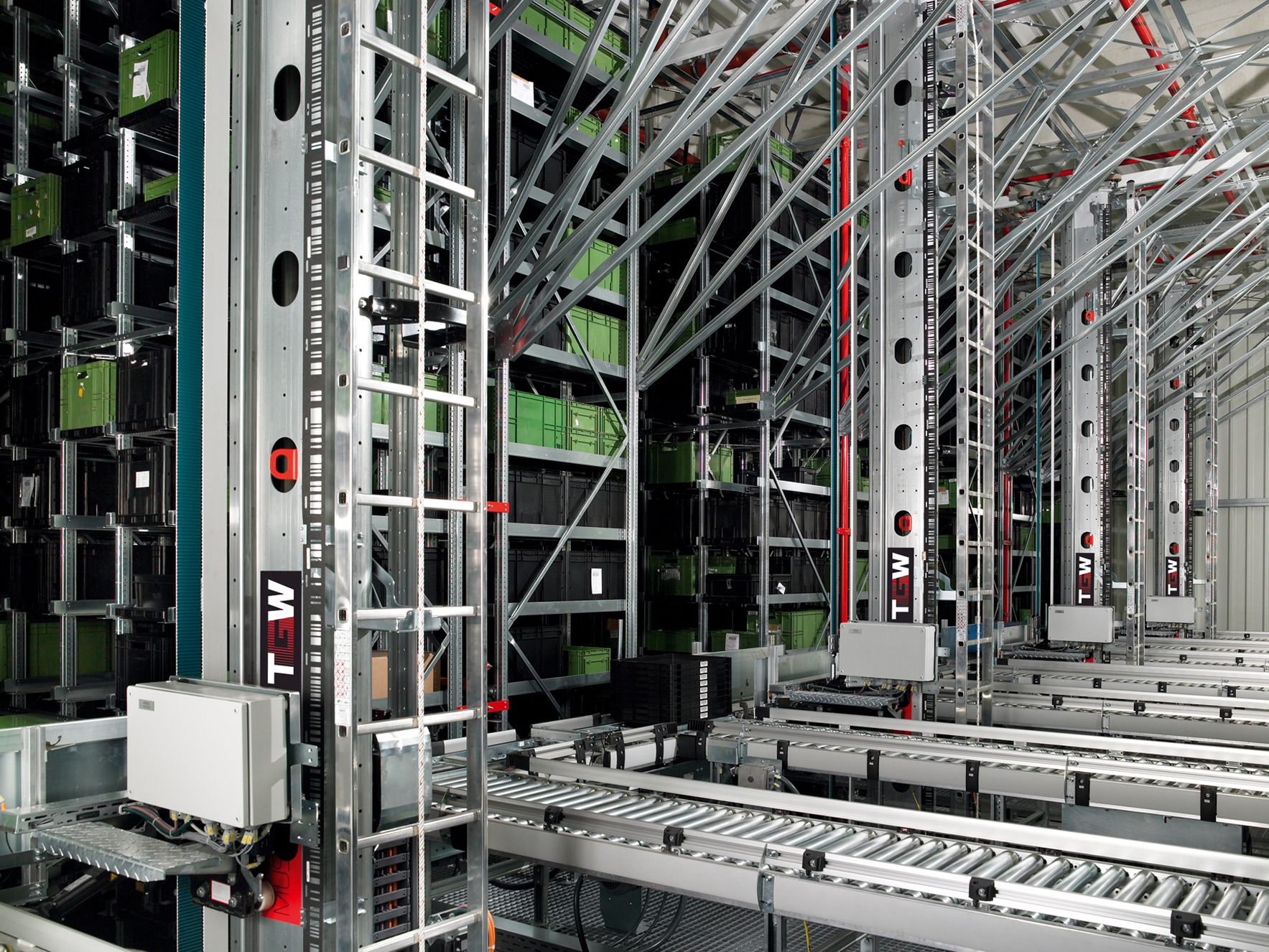
Figure Figure 4.7 shows a shuttle-based system, a Generation 2 design that raises tote throughput by decoupling horizontal shuttling and vertical lifts.

Figure Figure 4.8 illustrates goods-to-person picking with a horizontal carousel, representative of Generation 1 mechanisms.
Figure Figure 4.9 illustrates deep-lane storage with shuttle assistance, another Generation 2 design.

Figure Figure 4.10 shows a cube-storage grid with robots that retrieve bins to ports, representative of Generation 3.

Figure Figure 4.11 shows mobile-shelf pods delivered by AMRs to workstations, another Generation 3 pattern.

References
S-shape routing means walking each aisle fully, turning at the end, and returning via the next aisle. It is simple to implement but can be suboptimal if pick density is low or slotting is poor.↩︎
Largest-gap routing means always walking to the next available pick location with the largest gap from the current position. It can be more efficient in certain layouts but requires more complex control.↩︎
Slotting assigns items to warehouse locations based on factors such as item size, weight, and picking frequency. Its objective often includes reducing picking effort.↩︎