Warehousing
  • Syllabus
  • Course modules
  • Assignments
  • Extra materials
  1. Storage Space Requirements, Forward-Reserve Allocation, and Replenishment
  • Warehousing
  • 1  Syllabus
  • Warehouse Operations and Performance Diagnosis
    • 2  Introduction to warehousing
    • 3  Warehouse functions and flows
    • 4  Warehouse systems
    • 5  Warehouse functionality
    • 6  Planning scales in warehousing
  • 7  Distribution Network Design and Facility Location
  • Storage Systems, Policies, and Storage Location Assignment
    • 8  Theses on Storage-Location Assignment
  • Storage Space Requirements, Forward-Reserve Allocation, and Replenishment
    • 9  Replenishment in practice
  • 10  Warehouse Sizing, Layout, and Material-Handling System Design
  • 11  Order-Picking System Design and Control
  • 12  Robotized and Automated Warehouse Systems
  • 13  Exam Preparation and Assignment Work
  • Tutorials
    • 14  Facility-location optimization
    • 15  Warehouse storage optimization
    • 16  Economic order quantity (EOQ) model
    • 17  Optimal lane depth for block stacking
    • 18  Product allocation and functional-area sizing
    • 19  Warehouse block-layout design
    • 20  Order picking: routing, batching, and scheduling
  • Assignments
    • 21  WH-AS1 - Diagnosis and Activity Profiling
    • 22  WH-AS2 - Storage Location Assignment and Space Requirements
    • 23  WH-AS3 - Warehouse Layout Improvement
    • 24  WH-AS4 - Order-Picking Improvement
    • 25  WH-AS5 - Intervention Trade-Off Analysis
    • 26  WH-FINAL - Management Report and Reproducible Code
    • 27  WH-PR - Report and Code Peer Review
    • 28  Report and Code Assessment Rubrics
  • Extra materials
    • 29  Practice questions
    • 30  Warehousing Tour D’Horizon
    • Complete slide catalog

Table of contents

  • By the end of this module, you can
  • Slides
  • Tutorials and tools

Storage Space Requirements, Forward-Reserve Allocation, and Replenishment

Course home / Module 04

Module 04 · Week 39 · Configure

Storage Space Requirements, Forward-Reserve Allocation, and Replenishment

Connect inventory rules, replenishment, and lane geometry to the space and service the warehouse needs.
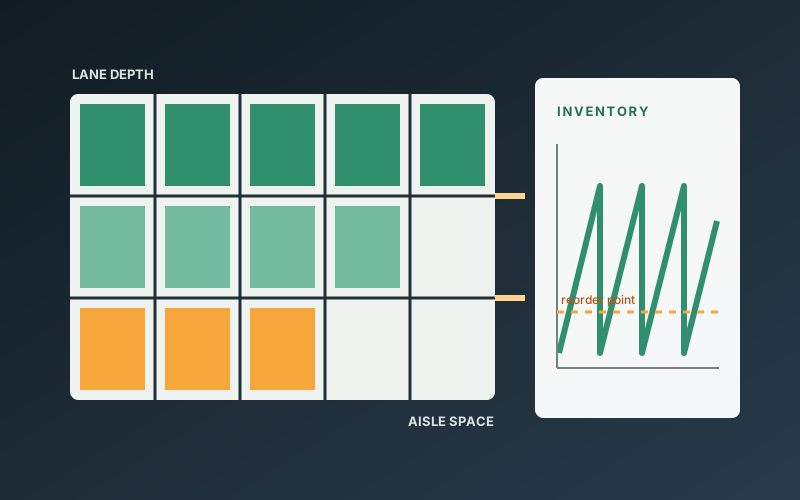
Storage lanes of different depths beside an inventory replenishment sawtooth.

Decision levelTactical capacity and inventory control

Core modelsEOQ, reorder logic, lane depth, and forward-reserve allocation

How much storage is enough when deeper lanes save aisles but create access and inventory costs?

Operating policy determines storage capacity. This module connects replenishment, order quantities, safety stock, product mix, lane geometry, and honeycombing so that space requirements become a modeled consequence of decisions.

By the end of this module, you can

  • estimate storage requirements from inventory and replenishment rules;
  • explain accessibility and honeycombing losses;
  • derive or use an optimal lane-depth model;
  • calculate EOQ, safety stock, and reorder logic under stated assumptions; and
  • connect inventory decisions to warehouse-space and service consequences.

Slides

Inventory management

Inventory rules, replenishment logic, safety stock, and service consequences.

Open deck

Layout and space allocation

Storage geometry, lane depth, honeycombing, and capacity trade-offs.

Open deck

Tutorials and tools

Work through the first four resources in the order shown.

Economic order quantity tutorial and dashboards

EOQ under demand uncertainty — spreadsheet

Replenishment in Practice

Optimal lane depth tutorial

Product-flow allocation and area-sizing tutorial

Warehouse & Distribution Science — open textbook

← Previous · Storage Systems, Policies, and Storage Location Assignment

Next · Warehouse Sizing, Layout, and Material-Handling System Design →

8  Theses on Storage-Location Assignment
9  Replenishment in practice